

Executive Cyber Security: Why Homes and Travel Are Now Part of the Attack Surface

Executive cyber security no longer stops at the corporate perimeter, and most leadership teams are not accounting for it. For senior leaders, board members, and high-net-worth individuals, the attack surface now extends into their homes, personal devices, and travel environments. That shift carries direct consequences for how leadership manages executive risk.
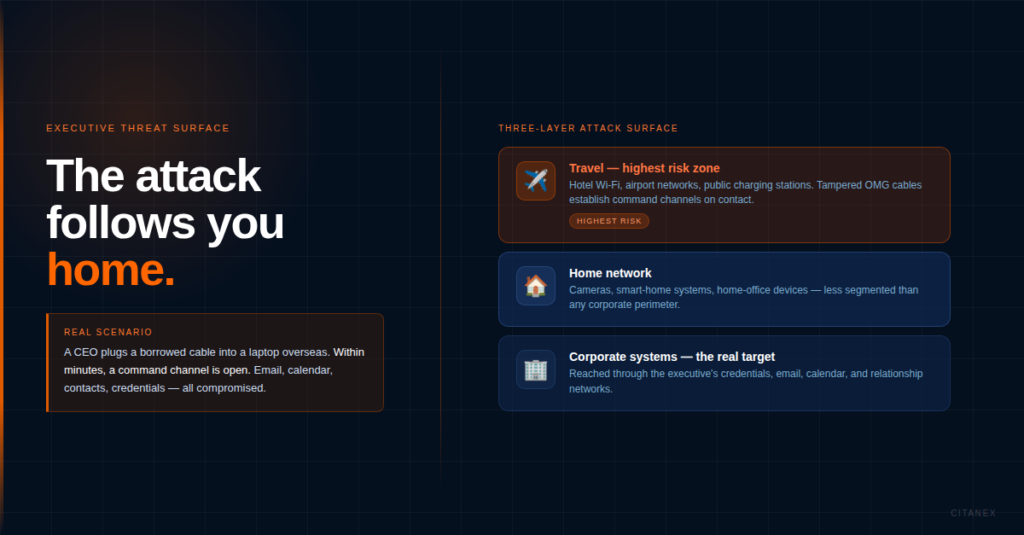
Here is a real scenario: a CEO plugs a borrowed charging cable into a laptop during an overseas business trip. Within minutes, a command channel opens. Within hours, an adversary has access to the executive’s email, calendar, contacts, and stored credentials. The breach did not start with a sophisticated exploit. It started with a USB cable.
This is the reality of the modern executive attack surface. In a geopolitical conflict environment, executives themselves become part of the target set.


How the Executive Cyber Security Perimeter Has Expanded
The modern threat environment no longer treats the office as the only target. Three personal environments now carry significant exposure for senior leaders.
The Executive Is the Target
Senior executives, board members, and high-profile individuals hold privileged access to corporate systems, strategic communications, financial decisions, and relationship networks that adversaries want.
As a result, that access makes them high-value targets for phishing, credential theft, surveillance, and account compromise. In state-linked operations, the goal often has nothing to do with immediate financial gain. Instead, it is intelligence collection, leverage, or a stepping stone into broader corporate systems. Consequently, the individual becomes part of the attack surface, not just the organization they lead.
Home Networks Cannot Meet Executive-Level Risk
Modern residences contain dense networks of connected devices: cameras, smart-home systems, remote-access platforms, Wi-Fi-connected appliances, and home-office systems that frequently connect back to corporate infrastructure.
These environments typically run less segmented and less monitored. In practice, a home network offers a softer entry point into the executive attack surface than the front door of a well-defended enterprise.
Travel Environments Introduce Exposure Leaders Cannot Afford to Ignore
Travel environments expose executives to untrusted networks, unfamiliar infrastructure, physical observation, and regional threat actors. Executives routinely connect to hotel Wi-Fi, airport networks, and public charging stations that threat actors may have already compromised.
Beyond the network itself, even routine accessories introduce risk. Tampered charging cables and adapters can establish command channels, enable data exfiltration, or create persistence on a device once connected. This is not theoretical. Citanex has documented how devices like modified OMG cables compromise executive devices, and why iPhones remain high-value intelligence targets for sophisticated adversaries.
Taken together, cyber exposure now spans enterprise networks, personal devices, home environments, and travel infrastructure. For executives and high-net-worth individuals, personal cyber risk is no longer separate from professional risk. The two connect directly, and the weakest point often sits furthest from the IT department.
What Executive Leadership Must Review Now
For executives and high-profile individuals, cyber protection now requires looking beyond the corporate security perimeter. With that in mind, leaders should evaluate each of the following areas.
Residential network security. Has leadership segmented the home network? Does leadership maintain an inventory of connected devices? Could a compromised home system provide a path back into corporate infrastructure?
Travel device discipline. Do travel devices stay hardened and separate from primary work devices? Specifically, do executives use only trusted accessories, including charging cables and adapters?
Family and household exposure. Spouses, children, assistants, and household staff who interact with shared systems or networks can become inadvertent entry points. Their digital hygiene is part of the executive attack surface.
Personal communications security. Phishing and social engineering campaigns frequently target personal email, messaging platforms, and social media accounts. In many cases, a compromised personal account becomes a bridge into professional systems.
Citanex Seraphim™ delivers managed protection for leadership environments where digital and physical risk intersect. It covers residential network security, travel device hardening, family exposure, and personal communications, giving executives and their households continuous protection across every part of their attack surface.
To learn more or request an assessment, contact us.
Read the Full Analysis
The full Citanex analysis explains how Iranian cyber activity intersects with enterprise systems, executive environments, and residential technology.
Full report: The Invisible Front: How Iran’s Cyber War Reaches Your Hospital, Bank, and Home
Executives and high-risk individuals concerned about personal exposure can explore Citanex Seraphim, a managed protection program designed for leadership environments where digital and physical risk intersect.


