


A healthcare cyber attack is no longer a random event. Hospitals are no longer just victims of opportunistic crime. Instead, in a conflict environment, they can become deliberate targets chosen for the disruption they create.


Why a Healthcare Cyber Attack Works as a Strategic Weapon
Healthcare sits where several conditions meet, and that combination makes it a clear target during conflict-driven campaigns. Three factors stand out for leadership to understand.
When Hospitals Go Down, the Consequences Go Far Beyond IT
Healthcare groups support life-critical services. Even limited disruption can set off a chain of effects that reach well beyond the IT department. Because of this, those behind a hospital cyberattack know it carries far more weight than a data breach at a retail firm.
Electronic records, lab systems, scheduling tools, and supply platforms are now tightly linked to care delivery. So when those systems slow or fail, clinical teams feel the impact almost immediately.
The Attack Does Not Have to Reach the Bedside to Do Damage
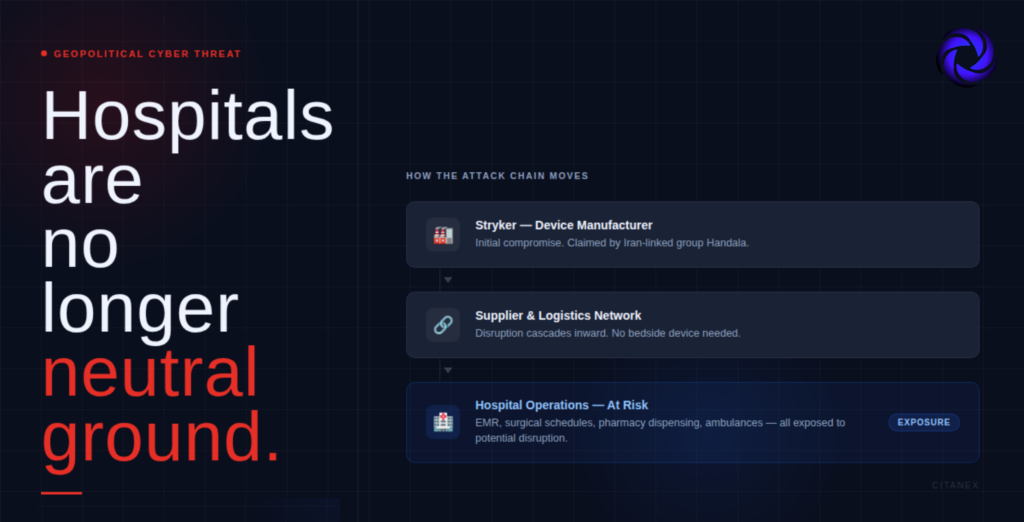
Healthcare networks extend far beyond the hospital itself. Device makers, shipping firms, remote-access tools, and supplier portals all form part of the chain. Crucially, those behind a healthcare cyber attack do not need to reach patient devices directly to cause serious harm. In fact, hitting a supplier can still introduce delay, confusion, and added risk across the whole network.
The 2026 attack on U.S. device maker Stryker, claimed by the Iran-linked group Handala, shows this clearly. The attack did not target patient care directly. Even so, its reach into the supply chain was enough to confirm the risk.
Disrupting Healthcare Is Not a Side Effect. It Is the Point.
Healthcare groups hold a unique place in public life. Disrupting them draws attention and creates doubt, especially during times of conflict. For this reason, those behind these attacks often treat a cyber attack on hospitals not as a side effect, but as the goal itself.
Conclusion
Healthcare systems now exist inside the broader cyber conflict space. As a result, a healthcare cyber attack is not a random crime of opportunity. It is a calculated move in a wider conflict. The logic is simple: disrupting hospitals produces visible effects that few other targets can match.
What Healthcare Leadership Must Do After a Cyber Attack on Hospitals
Hospital leaders should treat the current climate as a test of core strength, not simply an IT concern. In practice, that means acting on four clear steps before a disruption occurs.
- Harden internet-facing systems that support clinical care.
- Fix known weak points across hospital and supplier networks.
- Strengthen login security and identity checks for clinical staff and managers.
- Improve monitoring across systems that support patient care and hospital supply chains.
Beyond these steps, leadership should know which systems are truly critical before a disruption starts, not while it is happening. In a conflict-driven climate, the first point of failure often lies outside the hospital. It may start with a supplier tool, a remote-access system, or a third-party vendor that links into the hospital network. Therefore, mapping those links now is one of the most direct steps a leadership team can take.
Citanex works directly with hospital leadership teams to map these exposure points before a breach occurs. If your organization operates in healthcare or supports it, request a confidential assessment to understand where your critical links are most at risk.
Read More About How the Consequences of Cyber Attacks in Healthcare
This brief covers one part of a wider threat picture. The full analysis looks at how Iranian cyber activity connects with healthcare, finance, key infrastructure, and executive environments.
Read the full report: The Invisible Front: How Iran’s Cyber War Reaches Your Hospital, Bank, and Home
To understand how Citanex supports organizations facing a healthcare cyber attack or sector-specific threat, review our Healthcare Case Study.
Organizations with concerns about their specific exposure may also consider a Citanex Cyber Threat Intelligence (CTI) report to identify likely attack paths and the defensive steps that address them.