


The expanding cyber battlespace now extends directly into commercial operations. For decades, conflict was contained to land, sea, and air. Today, modern warfare spans six domains, and cyber is embedded in every military, economic, and psychological pressure campaign.
Here is what that means for business leaders: if your organization operates critical digital infrastructure, you already exist inside the expanding cyber battlespace. The question is not whether you are a potential target. It is whether you know where your exposure actually is.


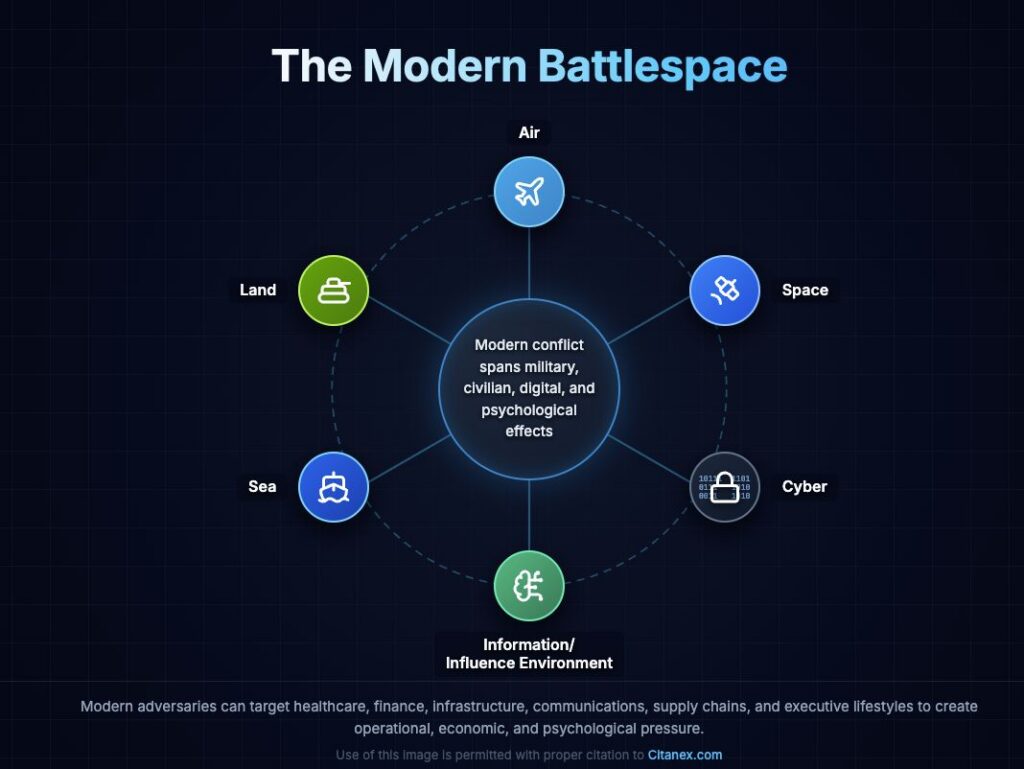
Why Business Has Become Part of the Operational Landscape
Digital infrastructure is now strategic terrain
Cloud platforms, telecommunications networks, data centers, identity systems, and industrial control environments are no longer just business infrastructure. Instead, they support essential national functions: communications, logistics, finance, and government operations.
When adversaries exploit the expanding cyber battlespace to disrupt these systems, the consequences reach far beyond the organization directly hit. As a result, they cascade through every business, customer, and partner that depends on that infrastructure.
Adversaries exploit asymmetry, not parity
Understanding the expanding cyber battlespace means understanding how adversaries think. Iran does not need to match the United States platform-for-platform across every military capability. It needs to find systems where relatively low-cost disruption produces outsized consequences.
That calculation points directly at sectors like healthcare, financial services, energy, logistics, and technology services. These industries are digitally dependent, publicly visible, and deeply interconnected. Consequently, disrupting them creates operational pressure, economic instability, and psychological impact that amplifies well beyond the initial incident.
Geopolitical cyber campaigns are not random
Organizations targeted during geopolitical escalation are typically selected because they are materially important, symbolically significant, or simply vulnerable enough to generate visible disruption. In most cases, they are all three.
The likely exposure set within the expanding cyber battlespace includes healthcare and life sciences, financial services, defense-adjacent businesses, critical infrastructure operators, cloud and technology providers, and logistics organizations whose compromise could serve as a stepping stone into a larger ecosystem.
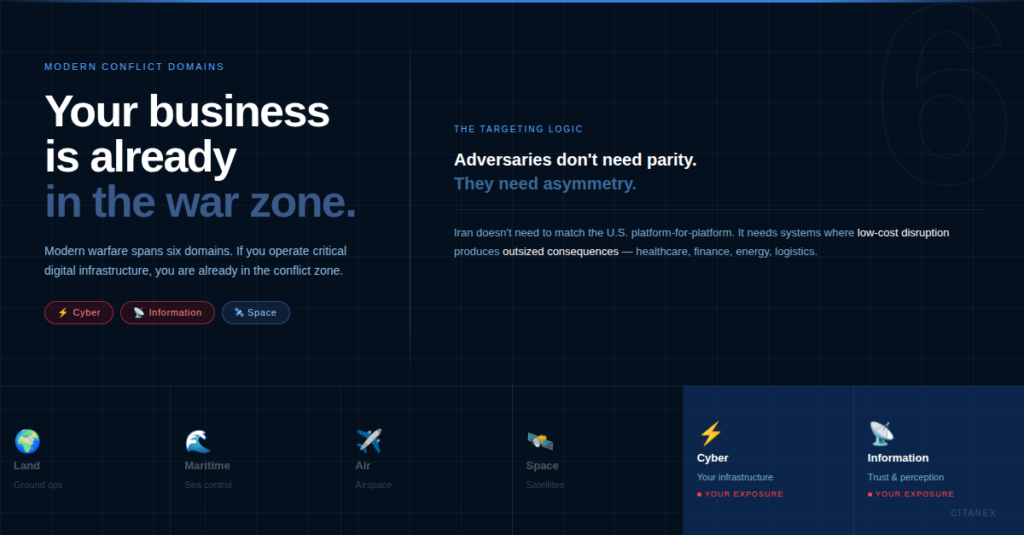
What the Expanding Cyber Battlespace Means for Business Leaders
The expanding cyber battlespace is not a problem that lives inside the IT department. Rather, it is a strategic resilience issue that requires leadership-level attention.
Executives should be asking:
Do we know which digital systems truly support our core operations? Not which systems we think are important, but which ones, if degraded for 72 hours, would materially impair our ability to serve customers, fulfill obligations, or maintain market confidence.
Where do our dependencies create exposure we do not control? Supplier platforms, cloud providers, SaaS tools, and third-party integrations all represent potential entry points outside the organization’s direct security perimeter.
Are we treating cyber resilience as an operational continuity issue or as an IT budget line? The organizations that recover fastest from a targeted disruption are the ones where leadership understood the risk landscape before the incident, not after.
Citanex works with executive teams, enterprise organizations, and family offices to map real exposure across digital systems, third-party dependencies, and leadership environments before a disruption occurs due to the expanding cyber battlespace. Our advisory practice is built on U.S. Secret Service-trained expertise and active threat intelligence spanning 21 sectors and 71 countries. We do not sell software. We provide the independent assessment that tells leadership exactly where they stand.
To request a Citanex Cyber Threat Intelligence (CTI) report for your organization, contact us.
Read the Full Analysis
The full Citanex analysis explores how the expanding battlespace affects healthcare systems, financial institutions, critical infrastructure, and executive environments.
Full report: The Invisible Front: How Iran’s Cyber War Reaches Your Hospital, Bank, and Home
Organizations seeking a clearer view of their exposure can request a Citanex Cyber Threat Intelligence (CTI) report.