

Pre-Case Digital Forensic Assessment: Stop Litigating on Assumptions
The case for conducting a pre-case digital forensic assessment before strategy, not after it.
Every litigation matter begins the same way. A client describes what happened. Counsel listens, forms a theory, and builds a strategy around it. Discovery requests follow. Counsel schedules depositions. Resources commit.
The forensic team examines the digital evidence later, often much later.
By the time a forensic team reviews the actual data, counsel has set the budget, established the position, and made changing course expensive. That sequence is the single most common and costly mistake in disputes where digital evidence is material. Moreover, it applies equally whether you are an executive facing litigation or an attorney managing a complex client matter on behalf of your firm.
A pre-case digital forensic assessment changes that sequence. This brief explains why the order in which you establish facts matters more than almost any other decision you will make early in a dispute.
 Loading ...
The Strategy Came Before the Pre-Case Assessment. That Is the Problem.
In most disputes with digital complexity, legal strategy forms before anyone has examined the technical facts or conducted a pre-case digital forensic assessment. Counsel is working from a client narrative, a description of events that may be accurate, partially accurate, or missing critical context that only the digital record can provide.
This is not a failure of legal judgment. It is a structural problem. Attorneys train to build the strongest possible case for their client. However, that instinct becomes a liability when the foundation of the strategy rests on unverified assumptions about what the digital evidence will show.
Consider what that means in practice. A company believes a departing executive stole proprietary data. Counsel builds a trade secret claim. Counsel retains investigators. Then the digital forensic assessment reveals that the file access patterns do not support the narrative, or that the data left the organization through a system the company itself misconfigured. Strategy, budget, and credibility all have to reset mid-matter.
Alternatively, a client assumes the evidence they need is gone. They settle for less than the case is worth because no one established early whether the data was actually recoverable. In both scenarios, the problem is the same: strategy preceded facts.
| The Core Principle Technical truth should be established before legal strategy is formed. Not alongside it. Before it. The cost of establishing facts early is significantly lower than the cost of discovering them late. |
Why This Problem Is Getting Worse, Not Better
Digital evidence is no longer a specialized subset of litigation. It is the primary evidentiary landscape. Modern disputes involve device examinations, cloud storage archives across multiple platforms, encrypted messaging applications, metadata embedded in documents, location data, deleted communication recovery, and AI-generated content that requires authentication.
Each of these evidence types carries its own forensic requirements. Each also creates its own failure mode when attorneys and clients handle it without technical grounding. Furthermore, as the volume and complexity of digital evidence grows, so does the gap between what legal teams assume the evidence will show and what it actually shows.
For law firms, this means that the standard practice of engaging forensic support mid-matter is increasingly inadequate. Clients bring disputes defined by digital evidence. The firms that serve them best build technical clarity into the earliest stage of the engagement, not as an add-on, but as a prerequisite to strategy.
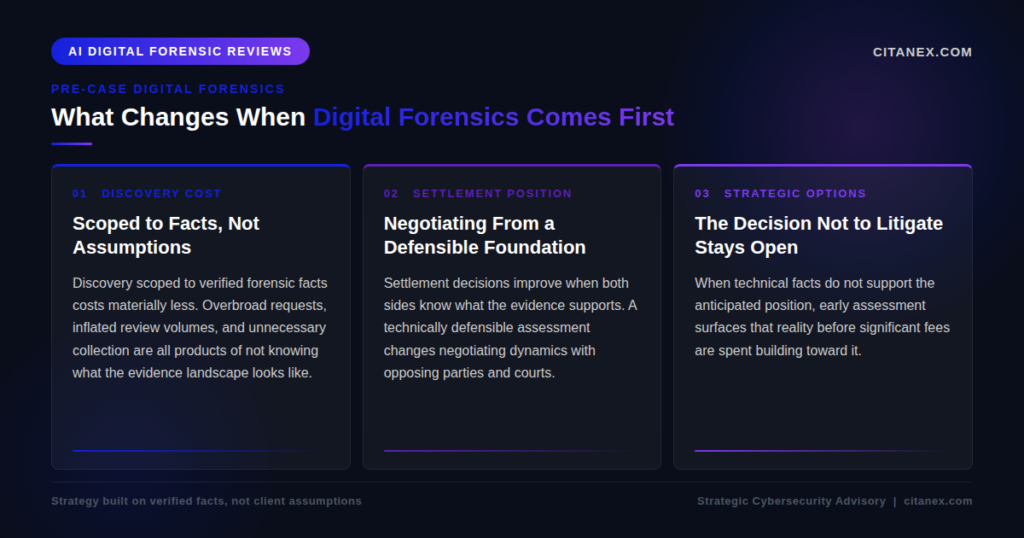
What Changes When Digital Forensics Comes First
A pre-case digital forensic assessment does not replace legal strategy. Instead, it gives strategy a foundation that holds up under scrutiny. Specifically, it answers the technical questions that determine whether a legal position is viable before the team commits to it.
For executives, that means knowing the actual strength of your position before authorizing a litigation budget. For attorneys, it means walking into strategy formation with verified facts rather than client assumptions and being able to advise clients with the kind of technical confidence that builds long-term trust.
There are three things early forensic assessment changes in practice:
- Discovery scoped to verified forensic facts costs materially less than discovery scoped to assumptions. Overbroad requests, inflated review volumes, and unnecessary collection are all products of not knowing what the evidence landscape actually looks like.
- Settlement decisions improve when both sides know what the evidence supports. A technically defensible forensic assessment changes negotiating dynamics. It gives counsel a credible foundation to present to opposing parties, mediators, and courts.
- The option not to litigate stays open longer. When technical facts do not support the anticipated position, early assessment surfaces that reality before the team spends significant fees building toward it. Setting strategy and committing resources eliminates that decision point.
The Independence Question
There is a specific reason why the forensic assessment should come from an independent technical authority rather than from resources under counsel’s direction.
An assessment conducted under a mandate to support a predetermined conclusion carries inherent credibility risk in adversarial proceedings. Opposing counsel will challenge it. Courts will scrutinize it. The findings become part of the litigation rather than the foundation beneath it.
In contrast, an independent forensic assessment, documented with full chain-of-custody records and produced under a methodology built to withstand Daubert admissibility standards, provides findings that function as a neutral technical baseline. Counsel can build strategy on that baseline with confidence in either direction. When the findings are strong, they anchor the case. When they are not, they inform the decision before it costs more to reverse it.
For law firms, this also means that the forensic expert’s credibility is not entangled with the advocacy position. That separation matters at deposition, at mediation, and at trial.
 Loading ...
What is The Right Time for a Pre-Case Digital Forensic Assessment?
The right time is before strategy forms. Not when discovery is underway. Not when the case needs an expert for trial. Before counsel has committed to a theory of the case and before the client has authorized a litigation budget.
For executives, that means engaging technical assessment at the same time you engage legal counsel, not after. For attorneys, it means building pre-case forensic review into your standard intake process for matters where digital evidence is material, which, in 2026, is most of them.
Citanex conducts pre-case digital forensic assessments that begin with a confidential technical consultation structured around the specific devices, accounts, and data sources at issue. Citanex produces a forensic findings report to evidentiary standards, with documented chain of custody and a technical interpretation that legal strategy can build on. A former US Secret Service Electronic Crimes Agent conducts every Citanex assessment. If the evidence matters to your case, it deserves that standard of review. Request your confidential consultation today.
For a full analysis of why digital forensic timing is a strategic variable, including the disputes where early assessment is most critical and the four questions every legal team needs answered before strategy is set, read the complete article: Digital Forensics First. Legal Strategy Second. Here’s Why.
To request a confidential consultation, contact Citanex today.