


The Decision Made Before the Evidence Is Examined
Most litigation strategies are built on assumptions, not on the verified findings of a pre-case digital forensic assessment. A client describes what happened. Counsel forms a theory of the case, mobilizes legal resources around that theory, retains investigators, schedules depositions, and files discovery requests.
The digital evidence is examined later, often much later, when the budget is committed, the position is set, and the cost of being wrong is at its highest.
A pre-case digital forensic assessment changes that sequence entirely. In any dispute where digital evidence is material, technical truth should be established before legal strategy is formed. Not alongside it. Before it.
This is the argument Citanex makes to every client who brings us a dispute with digital complexity: the cost of establishing technical facts early is significantly lower than the cost of discovering them late.
Why a Pre-Case Digital Forensic Assessment Now Defines Litigation Outcomes
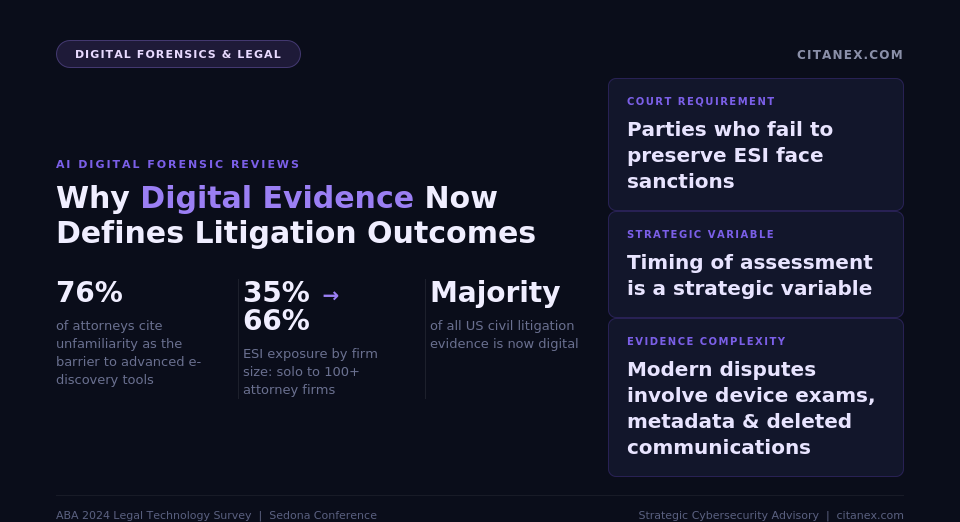
Digital evidence now represents a majority of evidence submitted in US civil litigation. Modern disputes involve device examinations, cloud archives, encrypted messaging, metadata, location data, and AI-generated content requiring authentication. Each evidence type carries its own forensic requirements and its own failure mode when handled incorrectly.
Courts have tightened their expectations accordingly. The 2015 Federal Rules amendments require parties to take reasonable steps to preserve electronically stored information once litigation is anticipated. Parties who fail face sanctions and adverse judicial findings. The ABA 2024 Legal Technology Survey found that 76% of attorneys cite unfamiliarity as the primary reason they do not use advanced review tools, identifying that knowledge gap as the single most significant obstacle to effective e-discovery practice. That gap does not close by bringing in a forensics team late. It closes by establishing technical clarity before strategy is formed.
The Real Cost Structure of Late-Stage Forensics
Timing is not a procedural detail. It is a cost driver. When digital forensic work begins after legal strategy is set, four consequences follow with predictable regularity. Discovery requests, drafted on assumptions about what data exists, come in overbroad. Review volumes inflate and costs multiply. A forensic expert retained mid-litigation reports what the evidence says; they do not retrofit those findings to the established theory of the case. Digital data is volatile, with storage systems that overwrite, cloud platforms that auto-delete, and device logs with hard retention limits, meaning evidence recoverable at the start of a dispute may not exist when the forensics team finally arrives. And under the Daubert standard, experts whose methodology cannot withstand scrutiny face admissibility challenges under Rule 702. Every one of these problems is more expensive to fix late than to prevent early.
What a Pre-Case Digital Forensic Assessment Establishes
A pre-case digital forensic assessment is a structured forensic review that Citanex conducts before formal legal proceedings begin, or at the earliest stage of an anticipated dispute. Its purpose is to establish technical truth before the legal team forms its strategy.
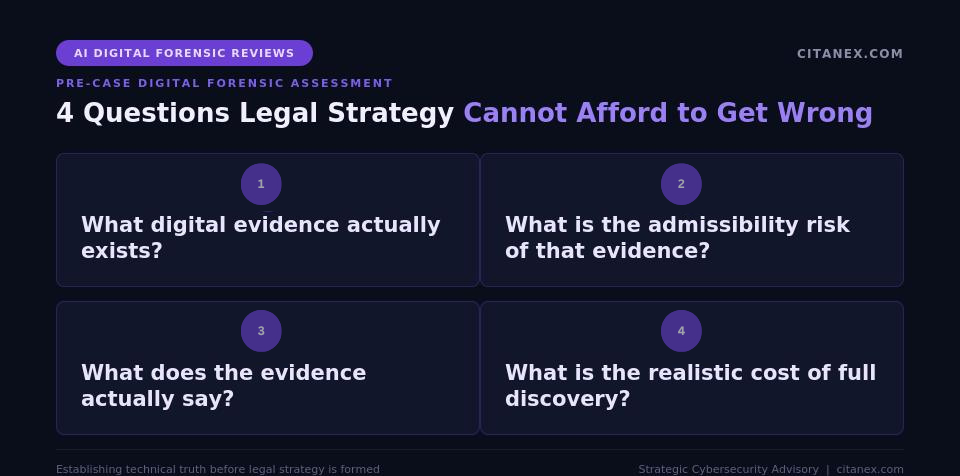
In practice, a Citanex Pre-Case Digital Assessment addresses four questions that legal strategy cannot afford to get wrong.
What digital evidence actually exists?
Assumptions about what data is recoverable are frequently wrong in both directions. A forensic assessment maps the actual evidence landscape before the team builds strategy on either assumption.
What is the quality and admissibility risk of that evidence?
Recoverable data is not automatically usable data. Metadata integrity, chain-of-custody documentation, authentication requirements, and hearsay considerations all affect admissibility. An independent pre-case digital forensic assessment identifies these risks before they become trial problems.
What does the evidence actually say?
Forensic experts interpret digital evidence; they do not simply read it. Metadata, device logs, and communication forensics each tell a technically defensible story independent of what any party’s narrative requires.
What is the realistic cost of full litigation discovery?
Before committing to a litigation strategy, a client deserves to know what discovery will actually require. A pre-case technical assessment scopes the forensic landscape, identifies custodians, estimates data volumes, and provides a realistic picture of collection complexity before the team sets the discovery budget.
Why Independence Matters, and Why eDiscovery Is Not a Substitute
Evidence collected, analyzed, and interpreted under a mandate to support a predetermined conclusion carries inherent credibility risk in adversarial proceedings. Independence is not a procedural nicety. It is an evidentiary asset. Findings produced by an independent firm, documented with full chain-of-custody records and built to withstand Daubert scrutiny, carry a credibility that advocacy-oriented analysis cannot match. Citanex’s forensics methodology draws on the investigative standards of former federal law enforcement professionals, including US Secret Service Electronic Crimes investigation practice. Every engagement produces findings designed to hold up under cross-examination regardless of which direction the technical facts point.
The financial case is equally direct. Discovery in complex commercial litigation ranges from hundreds of thousands to millions of dollars. A pre-case assessment that Citanex completes in several days represents a fraction of that cost and changes the decisions that drive it. Discovery scoped to verified forensic facts is materially less expensive than discovery scoped to assumptions. The assessment also creates a decision point that clients rarely have before they are deep into a matter: the option not to litigate. Where the technical facts do not support the anticipated position, a pre-case assessment surfaces that reality before the team has spent significant legal fees building toward it.
eDiscovery platforms are useful for what they were designed to do: manage large volumes of document review after collection. They were not designed to establish technical truth before legal strategy is formed. A pre-case digital forensic assessment is not a replacement for eDiscovery. It is the technical foundation that makes eDiscovery defensible and correctly scoped from the start.
The Disputes Where Pre-Case Digital Forensic Assessment Is Most Critical
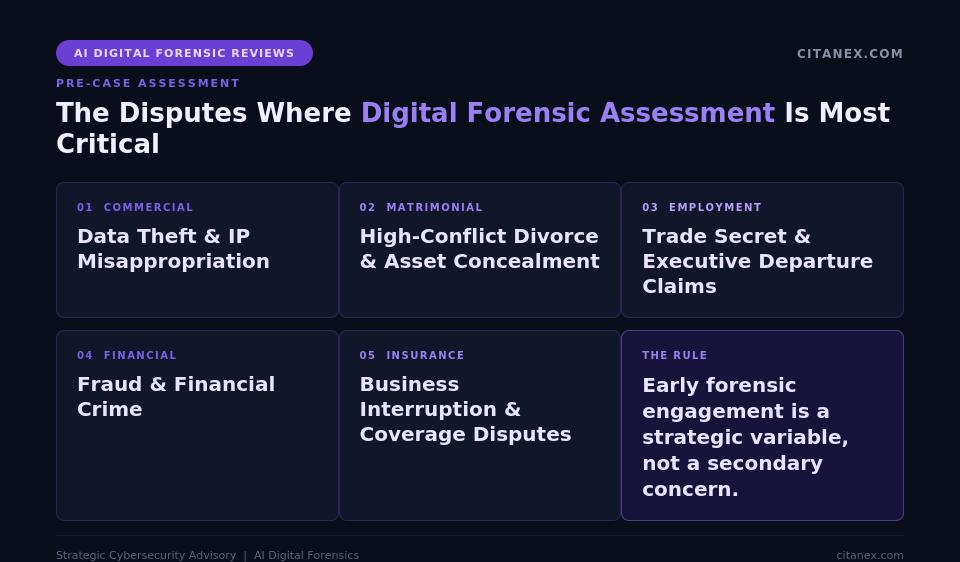
Not every dispute requires a pre-case digital forensic assessment. However, the following categories consistently present the conditions where early technical assessment delivers the greatest return.
Commercial disputes involving data theft, unauthorized access, or intellectual property misappropriation.
These matters are defined by digital evidence. Claim strength, defensibility, and settlement leverage all depend on what the forensics show.
High-conflict divorce proceedings involving complex financial structures or asset concealment allegations.
Digital data on personal devices is particularly volatile. Evidence present at the start of a dispute may not survive through discovery without forensic intervention at the outset.
Employment disputes involving trade secret claims, restrictive covenant violations, or executive departures.
These cases hinge on what data an employee accessed, copied, transmitted, or deleted, and when. Every day without forensic preservation reduces what investigators can establish with certainty.
Fraud and financial crime matters.
Pre-case assessment frequently determines whether prosecution or civil action is viable before resources are committed. Tracing transactions, recovering deleted records, and authenticating manipulated documents all require forensic engagement before the evidentiary window closes.
Insurance disputes and business interruption claims.
Policy disputes increasingly involve digital evidence of operational continuity, system logs demonstrating the scope of an incident, and technical analysis of causation. Pre-case forensics in this context produces the technical foundation for coverage arguments before counsel makes them.
A Note on Citanex’s Role
Citanex operates as an independent technical authority, not a law firm. We produce forensic findings. We do not provide legal advice, and we do not represent parties in litigation.
This separation is deliberate. An independent technical expert whose opinion counsel cannot dismiss as advocacy produces more credible findings in any adversarial context. When our assessment identifies a strong technical position, clients have the foundation to engage litigation counsel with verified facts. When our assessment identifies technical weaknesses, clients have the opportunity to make informed decisions before those weaknesses become expensive surprises.
Where appropriate, Citanex can refer clients to reputable litigation counsel who value evidence-driven strategy. We recommend counsel when the technical assessment supports moving forward and when the client’s legal needs require external representation.
The First Step: Request a Pre-Case Digital Forensic Assessment
A Citanex Pre-Case Digital Assessment begins with a confidential technical consultation. The consultation is structured around the specific devices, accounts, and data sources at issue. It covers the questions that legal strategy will need the forensics to answer, and includes a preliminary assessment of what is forensically recoverable.
From that consultation, we produce a scoped assessment plan with a defined methodology, a realistic timeline, and a clear deliverable: a forensic findings report produced to evidentiary standards, with documented chain of custody and a technical interpretation that the legal team can build strategy on.
The consultation is confidential. We deliver findings under privilege protection in coordination with retained counsel where applicable, and independently where the client requires an objective assessment before engaging legal representation.
The decision to litigate, settle, or decline engagement should be made on verified technical facts. The cost of establishing those facts early is significantly lower than the cost of discovering them late.
To request a confidential pre-case digital forensic assessment, contact us today.
Sources
1. Sedona Conference on Proportionality: 39362 sed_18
2. ABA Legal Technology Survey 2024: https://www.americanbar.org/groups/law_practice/resources/tech-report/2024/2024-litigation-and-tar-techreport/
3. FRCP Rule 37(e): https://www.law.cornell.edu/rules/frcp/rule_37
4. Daubert v. Merrell Dow: https://supreme.justia.com/cases/federal/us/509/579/