


Cyber threats to financial institutions are among the most consequential risks in modern geopolitical strategy. Financial institutions are among the most targeted organizations in state-linked cyber campaigns, and the objective is rarely theft.
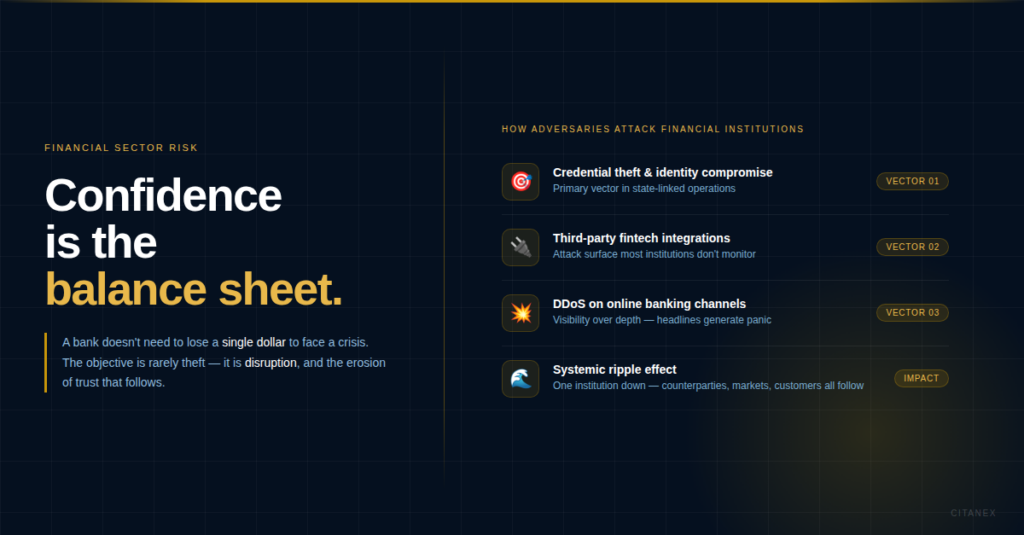
A bank does not need to lose a single dollar to face a cyber crisis. If customers cannot access their accounts for 48 hours, the damage is already done. Not to the balance sheet. To confidence. And in financial services, confidence is the balance sheet.
That is why cyber threats to financial institutions focus on disruption, reputational damage, and the erosion of trust that follows.
Cyber Threats to Financial Institutions: Why Disruption Is the Goal
Systemic importance beyond the institution itself
Banks are not isolated businesses. They sit at the center of economic activity. Payment networks, treasury operations, identity verification systems, and digital banking platforms underpin everyday commercial function for millions of businesses and individuals.
Disrupting one institution creates ripple effects across counterparties, markets, and customers. That interconnection is precisely what makes financial services valuable as a pressure point.
Confidence as a strategic vulnerability
Unlike most industries, financial services operate on a foundation of perceived reliability. If customers begin to question whether their accounts are accessible or their data is secure, the reputational damage can spread faster than the technical incident itself.
This is why cyber operations targeting banks frequently aim for visibility rather than depth. A distributed denial-of-service attack on online banking, a brief disruption to payment processing, or a public data exposure can generate headlines and anxiety that persist long after systems are restored.
Complex digital dependencies
Modern financial institutions run on deeply interconnected digital systems: internal platforms, payment networks, identity services, customer-facing channels, and an expanding ecosystem of fintech integrations and third-party providers.
Because these systems must operate continuously, even limited disruptions can produce outsized operational consequences. And the more interconnected the environment, the more entry points adversaries can explore.
What This Means for Financial Leadership
Executives managing cyber threats to financial institutions should treat cyber readiness as a continuity and confidence issue, not a compliance checkbox.
The questions that matter most:
What happens to customer confidence if digital channels go dark for 48 hours? Institutions that have not modeled this scenario are underestimating the reputational dimension of cyber risk.
How much operational dependency runs through third-party providers? Fintech integrations, payment processors, and service providers represent attack surface that most institutions do not fully control or monitor.
Is identity security resilient enough for a targeted campaign? Credential theft and identity compromise are primary vectors in state-linked operations against financial institutions. Authentication systems deserve particular scrutiny.
Citanex works with financial leadership teams to map real attack surface, stress-test continuity assumptions, and build cyber readiness that holds under pressure. Our work is grounded in U.S. Secret Service-trained expertise and active threat intelligence across 21 sectors and 71 countries.
To request a Citanex Cyber Threat Intelligence report for your institution, contact us.


Read the Full Analysis
This brief highlights one part of the broader cyber landscape. The full analysis explores how Iranian cyber actors target financial institutions alongside healthcare systems, critical infrastructure, and executive environments.
Full report: The Invisible Front: How Iran’s Cyber War Reaches Your Hospital, Bank, and Home
Financial organizations seeking deeper insight into sector-specific exposure can request a Citanex Cyber Threat Intelligence (CTI) report.