

Four Litigation Strategy Questions Your Forensics Must Answer First

A practical diagnostic composed of 4 litigation strategy questions for executives and attorneys who need verified facts before committing to a legal position.
Before your legal team commits to a litigation strategy, four technical questions need answers. Most teams skip them. Specifically, they form a position, authorize a budget, and engage resources. These teams then discover mid-matter that the digital evidence does not support what they assumed.
This brief presents those four litigation strategy questions as a practical diagnostic tool. Use it as an executive stress-testing your legal position before authorizing spend. Use it as an attorney building a pre-case forensic assessment into your client intake process. Either way, these questions determine whether your strategy rests on verified facts or on assumptions that will cost you later.
 Loading ...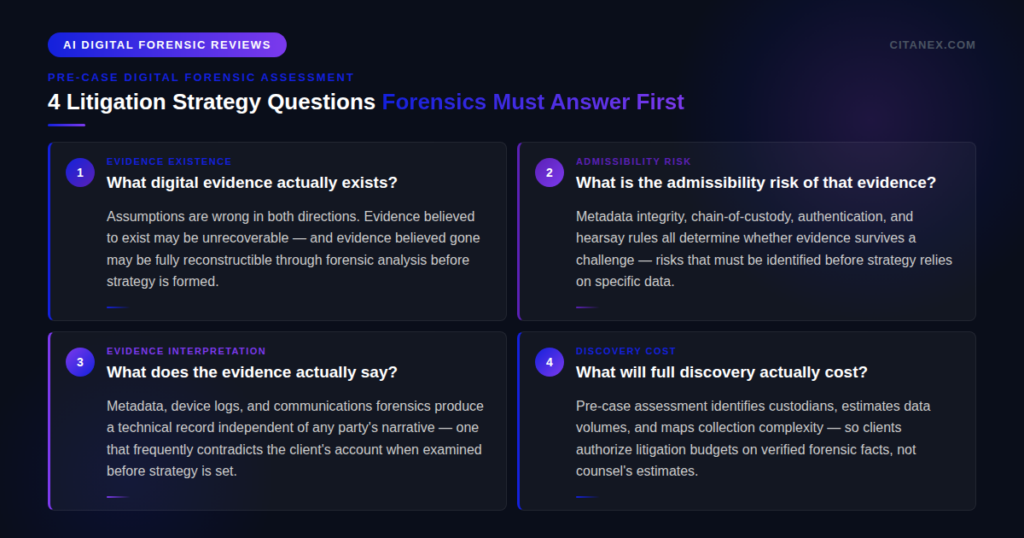
Litigation Strategy Question 1: What Digital Evidence Actually Exists?
This is the foundational litigation strategy question that pre-case forensic assessment answers first. Attorneys and clients routinely carry assumptions about what data survives and what does not. Those assumptions are frequently wrong in both directions.
Evidence teams often assume certain data exists and will be available when needed. In practice, deleted files, overwritten storage, and expired cloud retention can eliminate it entirely. Conversely, data teams assume is gone (deleted messages, wiped devices, cleared browser histories) is often fully reconstructible through forensic analysis.
Therefore, building litigation strategy on either assumption without technical verification is a structural risk. A pre-case forensic assessment maps the actual evidence landscape before your team builds anything on top of it.
Litigation Strategy Question 2: What Is the Admissibility Risk of That Evidence?
Recoverable evidence is not automatically usable evidence. Consequently, your litigation strategy needs to account for admissibility risk before it relies on specific data.
Four factors determine whether digital evidence survives a challenge:
- Metadata integrity: whether the data shows signs of tampering or modification after the fact.
- Chain-of-custody documentation: whether a verified record traces every hand that touched the evidence from collection to court.
- Authentication requirements: whether the evidence meets the legal standard for establishing what it claims to be.
- Hearsay considerations: whether the digital record qualifies under applicable exceptions.
Pre-case forensic assessment identifies these risks before they surface at trial. Moreover, it gives legal strategy a realistic picture of which evidence holds up and which requires additional foundation work before it reaches a courtroom.
| Why Independence Matters Here A forensic assessment conducted by an independent firm, under a methodology built to withstand Daubert scrutiny, produces admissibility findings that advocacy-oriented analysis cannot match. Citanex designs every engagement to hold up under cross-examination, regardless of which direction the technical facts point. |
Litigation Strategy Question 3: What Does the Evidence Actually Say?
This is where most litigation surprises originate. Digital evidence does not speak for itself. Forensic experts interpret it and that interpretation often contradicts what the client described or the current established litigation strategy.
Metadata tells a story about when a document was created, modified, and by whom. Device logs record physical location and application activity at specific times. Communication forensics reveal what someone sent, when they sent it, and whether they deleted it afterward. In each case, the technical record is independent of any party’s narrative.
For executives, this means that your litigation strategy needs to account for what the evidence actually shows, not what you believe it shows. For attorneys, it means that the pre-case forensic assessment is the moment you discover whether your client’s account aligns with the technical record. Finding that out before strategy forms costs far less than finding it out at deposition.
Loading ...Litigation Strategy Question 4: What Will Full Discovery Actually Cost?
Discovery in complex commercial litigation strategy ranges from hundreds of thousands to millions of dollars. Most clients authorize a litigation budget without a verified picture of what discovery will require. That gap between assumed cost and actual cost is one of the most predictable sources of mid-matter friction.
Pre-case forensic assessment scopes the evidence landscape before discovery begins. It identifies custodians, estimates data volumes, maps collection complexity, and produces a realistic picture of what full discovery will require. As a result, clients make budget decisions on verified forensic facts rather than counsel’s estimates based on client descriptions.
Furthermore, early scoping changes what gets collected. Discovery scoped to a verified forensic foundation is materially less expensive than discovery scoped to assumptions. The assessment pays for itself in the cost reduction it produces downstream.
How Citanex Answers These Four Questions for Your Matter

Citanex conducts pre-case forensic assessments that address all four questions before legal strategy forms. Our methodology draws on federal investigative standards developed through US Secret Service Electronic Crimes investigation practice. We build every engagement to produce findings that hold up under cross-examination.
- For law firms, our pre-case assessment integrates directly into your client intake process for matters where digital evidence is material. We give your team technically verified answers to the four questions above, early enough to drive strategy, not disrupt it.
- For executives and in-house counsel, our assessment gives you the technical clarity to make three decisions with confidence: whether to litigate, what discovery will cost, and whether the evidence supports the position your legal team is building toward.
Every engagement begins with a confidential consultation structured around the specific devices, accounts, and data sources at issue. The output is a forensic findings report produced to evidentiary standards, with full chain-of-custody documentation.
Loading ...| Get your four questions answered before strategy forms. Book a confidential Citanex consultation today. Want the full case for why forensics must come before legal strategy? Read: Digital Forensics First. Legal Strategy Second. Here’s Why. Learn more about how The Most Expensive Decision in Your Dispute Happened Before You Hired a Lawyer. |