


The legal standards shaping digital evidence in litigation today, and the knowledge gap putting your matters at risk.
Courts raised the bar on digital evidence in litigation. Most legal teams have not kept pace. That gap drives most avoidable failures in complex matters today.
This brief covers three things: what the current legal standards require, where most legal teams fall short, and why closing that gap starts before you issue a single discovery request.
 Loading ...
How the Legal Landscape for Digital Evidence in Litigation Has Shifted
The 2015 Federal Rules amendments established a uniform standard for managing electronically stored information (ESI) based on reasonable preservation steps. While courts may order curative measures to address prejudice from lost data, adverse inference instructions require a specific finding of intent to deprive an opponent of the information. This ensures the most severe sanctions target intentional culpability rather than simple negligence.
Proportionality is now central to discovery. Parties must demonstrate that their approach is reasonable relative to the needs of the case. That applies to what data teams collect, how they collect it, when they collect it, and under what methodology they preserve and produce it.
Furthermore, the Sedona Conference, which provides authoritative guidance on e-discovery law, documents how courts scrutinize collection methodology, not just collection results. Courts now ask: how did you decide what to look for, and how did you preserve it? That question demands a technical answer, not a legal one.
| What This Means in Practice A party that waits to engage forensic expertise until discovery is underway may already fall behind the standard courts apply. Reasonable preservation of electronically stored information begins when litigation is reasonably anticipated, not when it is formally filed. |

The Numbers That Should Concern Every Legal Team Handling Digital Evidence
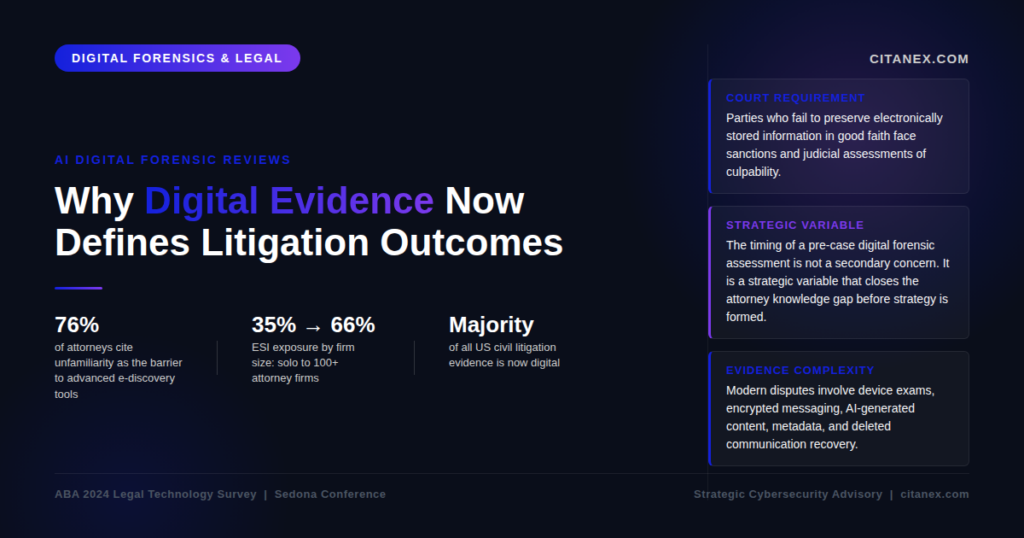
The ABA 2024 Legal Technology Survey on Litigation Technology and E-Discovery documents the scale of the problem across the profession.
| 76% | of attorneys cite unfamiliarity as the primary reason they do not use advanced e-discovery review tools, identified as the single largest obstacle to effective handling of digital evidence in litigation. |
| 35% to 66% | ESI exposure by firm size: from solo practitioners to firms of 100 or more attorneys, the majority of legal professionals now regularly encounter electronically stored information in their matters. |
| No. 1 gap | Attorney knowledge, not technology availability, is the primary barrier to competent management of digital evidence in litigation across all firm sizes. |
These numbers describe the baseline competency gap across the legal profession on the type of evidence that now dominates civil litigation. Moreover, this gap does not close by bringing in a forensics team late. It closes by building technical clarity into the matter from the start.
The Admissibility Risk in Digital Evidence in Litigation Most Teams Miss
Preserved and collected digital evidence in litigation still needs to be admissible. The Daubert standard gives federal judges a gatekeeping role over expert testimony. Experts whose methodology lacks controlling standards face exclusion under Rule 702.
Courts exclude digital forensic testimony for three reasons:
- First, the methodology lacks scientific defensibility.
- Second, chain-of-custody documentation is incomplete.
- Third, the expert’s findings appear shaped by the retaining party’s advocacy position.
For law firms, this creates a direct problem. An expert retained after legal strategy is set carries a credibility burden at deposition, at mediation, and at trial. An independently engaged expert does not carry that burden. Therefore, the timing of forensic engagement shapes both the admissibility and the weight of expert findings, not just their substance.
Loading ...Three Things Competent Electronically Stored Information Handling Requires
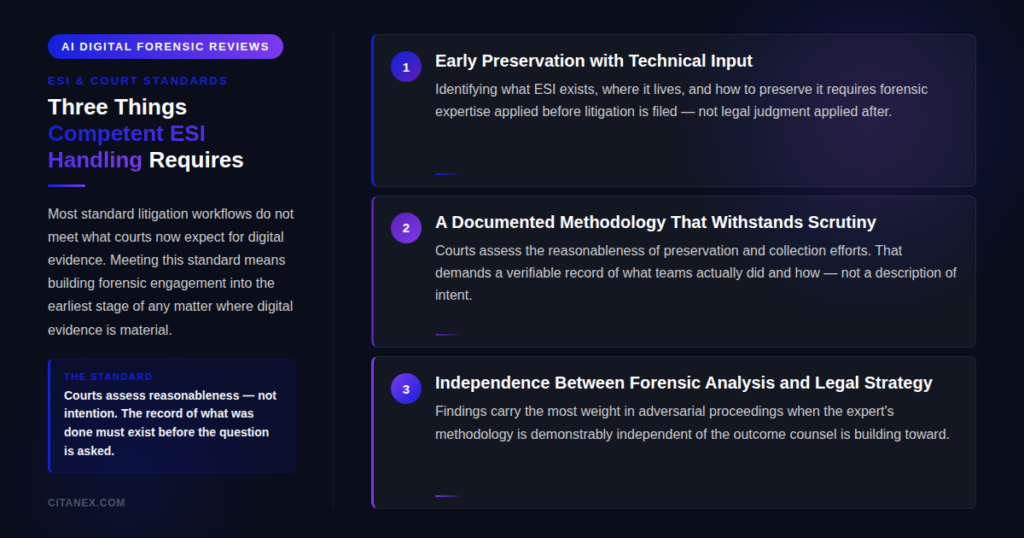
Most standard litigation workflows do not meet what courts now expect for digital evidence in litigation. Competent handling requires three things:
- Early preservation with technical input. Identifying what ESI exists, where it lives, and how to preserve it before litigation is filed requires forensic expertise, not legal judgment alone.
- A documented methodology that withstands scrutiny. Courts assess the reasonableness of preservation and collection efforts. That demands a record of what teams actually did and how, not a description of what they intended.
- Independence between forensic analysis and legal strategy. Findings that carry the most weight in adversarial proceedings come from experts whose methodology is not shaped by the outcome counsel needs.
For law firms, meeting this standard means building forensic engagement into the earliest stage of any matter where digital evidence in litigation is material. That is not the current norm. However, courts increasingly apply this expectation when evaluating how parties handled their obligations.
The Competitive Implication for Law Firms
There is a competitive dimension here that goes beyond compliance. Clients who navigate complex digital disputes remember how their legal team handled the evidence. They remember whether their attorneys had technical answers or were caught off guard by what the forensics showed.
Firms that integrate independent forensic assessment into their standard engagement model build demonstrable technical competency. Clients with recurring litigation exposure notice this and value it. Walking into strategy formation with verified technical facts on digital evidence in litigation, rather than assumptions, differentiates how firms advise and how clients evaluate them over time.
Loading ...How Citanex Closes the Gap
Citanex is an independent digital forensics firm founded by a former US Secret Service Electronic Crimes Agent. We bring federal investigative methodology to civil and commercial matters, producing forensic findings that hold up under cross-examination regardless of which direction the technical facts point.
We work directly with law firms and their clients. Our role is not to support a predetermined legal conclusion. Our role is to establish what the digital evidence in litigation actually shows, early enough for that finding to drive strategy, not disrupt it.
Every Citanex engagement delivers three things that standard e-discovery workflows do not:
- An independent forensic assessment conducted before legal strategy forms, scoped to the specific devices, accounts, and data sources at issue.
- A forensic findings report produced to evidentiary standards, with full chain-of-custody documentation and a methodology built to withstand Daubert scrutiny.
- A technically defensible interpretation of what the evidence supports, delivered early enough to inform settlement decisions, discovery scope, and trial strategy.
For law firms, Citanex functions as a technical partner for matters where digital evidence is material. We strengthen your ability to advise clients with verified facts, and we produce findings you can present to opposing parties, mediators, and courts with confidence.
For executives and in-house counsel, we provide the technical clarity that legal strategy needs before it forms. When the findings are strong, you go forward with a verified foundation. When they are not, you make that decision before it costs significantly more to reverse it.
| Ready to establish technical clarity before strategy forms? Book a confidential consultation with Citanex. Want the full picture on why digital forensics must come before legal strategy? Read the full article: Digital Forensics First. Legal Strategy Second. Here’s Why. |
Sources
1. Sedona Conference on Proportionality: 39362 sed_18
2. ABA Legal Technology Survey 2024: https://www.americanbar.org/groups/law_practice/resources/tech-report/2024/2024-litigation-and-tar-techreport/
3. FRCP Rule 37(e): https://www.law.cornell.edu/rules/frcp/rule_37
4. Daubert v. Merrell Dow: https://supreme.justia.com/cases/federal/us/509/579/