Cyber Threat Intelligence Report (CTI)
$3,000.00
Cyber Threat Intelligence Report (CTI)
Turn Digital Exposure Into Actionable Intelligence
Protect your organization with a comprehensive analysis of your external attack surface, public data exposures, and dark web threat indicators. Our structured, fact-based reporting empowers executives and security teams to proactively mitigate vulnerabilities and secure critical assets before a breach occurs.
Description
Cyber Threat Intelligence Report (CTI)
Turn Digital Exposure Into Actionable Intelligence
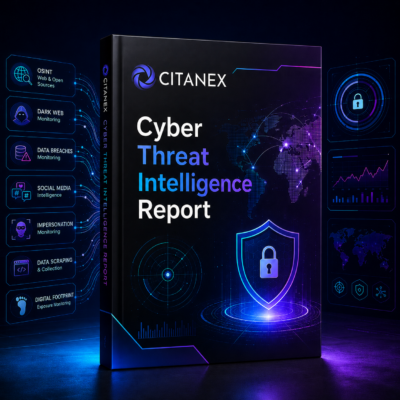
Description:
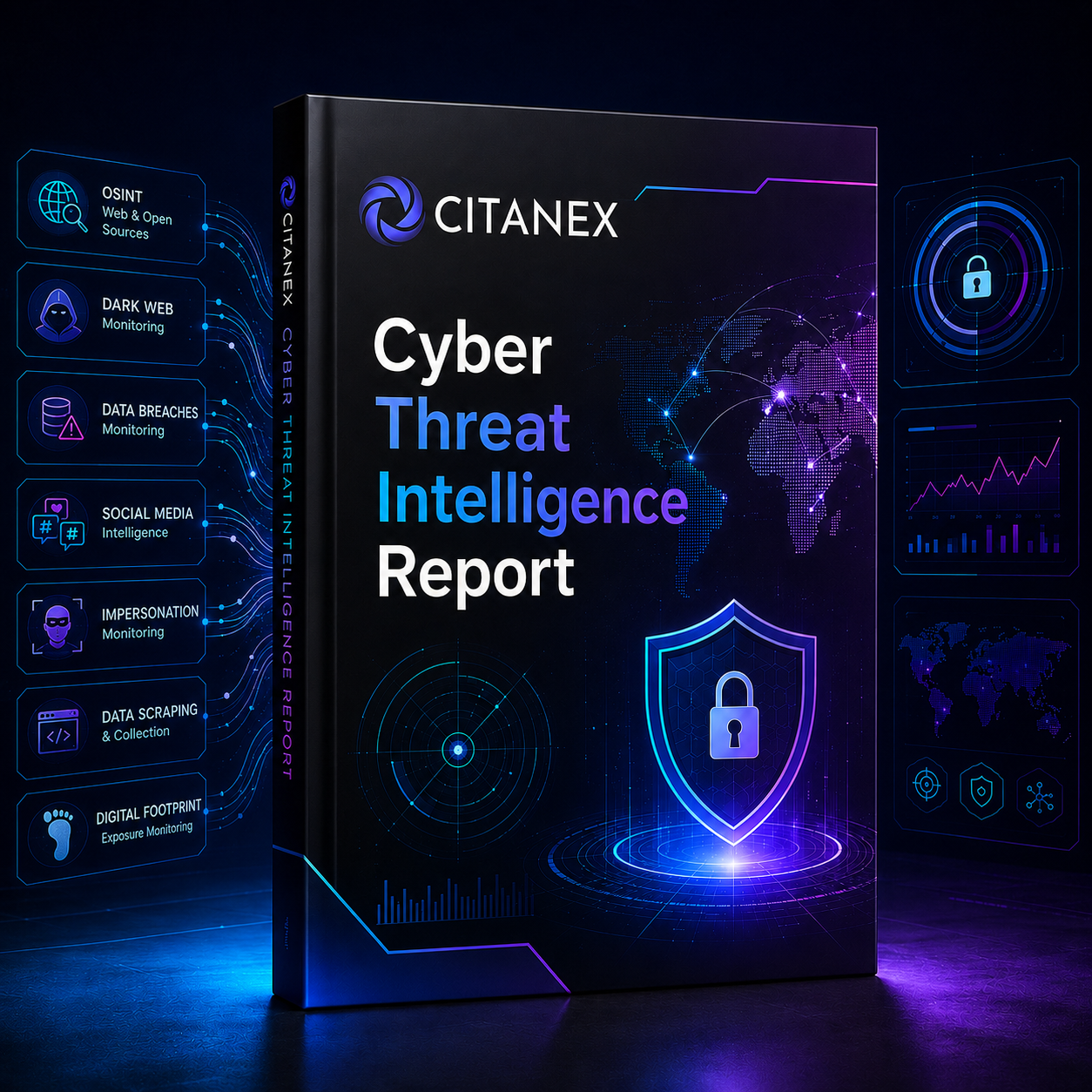
The Citanex Cyber Threat Intelligence Report (CTI) is designed to identify, analyze, and document cyber threat intelligence indicators, digital exposures, attack surface risks, threat actor references, compromised-data observations, infrastructure associations, dark web intelligence, and other cyber-related information relevant to the scope of the assessment.
The objective of this assessment is to compile fact-based, attributable, and reviewable intelligence derived from publicly accessible, lawfully obtained, and cyber-relevant sources. Findings are organized to help organizations, legal counsel, investigators, insurers, executives, and authorized parties better understand potential threats, exposures, targeting indicators, and areas that may warrant further review or mitigation.
Order Now: Don’t leave your organization’s digital exposures unaddressed. Contact us today to schedule an initial consultation and get the actionable threat intelligence you need.
Testimonials
“This report gave us clear visibility into our internet-facing infrastructure and public exposures. The structured data allowed our security team to immediately mitigate high-priority risks before they could be exploited.” – David K., Chief Information Security Officer (CISO)
“As legal counsel, I need fact-based and reviewable intelligence for risk assessments. This service provided deep dark web insights and concrete source context that standard assessments completely missed.” – Sarah M., Corporate Cybersecurity Attorney
Q: What is A Cyber Threat Intelligence Report (CTI)?
A: A Cyber Threat Intelligence Report (CTI) is a comprehensive digital risk assessment that identifies, analyzes, and documents an organization’s public exposures, internet-facing infrastructure risks, and threat actor indicators. Derived from publicly accessible, lawfully obtained, and dark web intelligence sources, the report provides structured, fact-based findings to support cybersecurity planning, risk management, and executive decision-making.
Important Note: We do not provide legal advice. However, we are happy to refer customers to lawyers and law firms who have demonstrated effective results in the past and service our clients with the highest standards and ethics. Please note, however, that past results are not indicative of future results. If you are unhappy with any lawyer or law firm referral, please let us know!
Initial Consultation: To ensure that we fully understand your needs and can provide the most effective service, we offer an initial consultation for a fee of $100. This fee will be credited towards the full service if you decide to proceed.
Key Features:
- Identification of publicly exposed digital assets, internet-facing infrastructure, domains, IP addresses, email addresses, and other cyber-relevant identifiers.
- Review of compromised-data references, credential exposure observations, breach-related indicators, and publicly reported cyber incidents.
- Analysis of attack surface risks, technology exposure indicators, and observable security-related findings.
- Identification of threat actor references, targeting indicators, impersonation activity, brand abuse observations, and other cyber threat intelligence signals where applicable.
- Review of dark web, deep web, and publicly accessible intelligence sources for relevant threat-related information.
- Correlation of cyber intelligence findings across multiple sources to identify patterns, relationships, and areas requiring additional review.
- Documentation and preservation of relevant source context, including screenshots, source references, timestamps, URLs, and observable intelligence relationships.
- Identification of findings that may warrant additional investigation, monitoring, remediation efforts, incident response activities, or technical validation.
- Organization of findings into a structured, reviewable format designed to assist security teams, executives, risk managers, investigators, insurers, and authorized stakeholders with threat awareness, risk management, and informed decision-making.
- Structured reporting designed to support cybersecurity planning, risk assessments, threat-informed security strategies, executive decision-making, due diligence efforts, and operational resilience.
Who Can Benefit:
-
Organizations & Corporations: Identify external digital vulnerabilities and protect internet-facing infrastructure before a breach occurs.
-
Security Teams & CISOs: Gain actionable intelligence, track credential exposures, and prioritize proactive mitigation strategies.
-
Legal Counsel & Investigators: Secure fact-based, reviewable threat intelligence to support corporate due diligence and investigation efforts.
-
Cyber Insurers & Risk Managers: Evaluate external attack surfaces and assess exposure risks for informed underwriting or policy renewals.
-
Executives & Authorized Stakeholders: Access structured, objective reporting to make informed decisions and enhance operational resilience.
How It Works:
- Order the Service: Based on the consultation and defined scope, proceed with ordering the Cyber Threat Intelligence Report (CTI).
-
Initial Consultation: Schedule an initial consultation to discuss the evaluation scope, corporate digital assets, and specific risk management objectives.
-
Intelligence Gathering: Our intelligence analysts conduct a comprehensive review of internet-facing infrastructure, dark web networks, credential exposure databases, and publicly accessible threat signals.
-
Analysis & Correlation: We assess attack surface risks, map observable threat indicators, correlate findings across multiple sources, and identify patterns requiring technical validation.
-
Detailed Report Delivery: Receive a secure, private link to access your structured Cyber Threat Intelligence Report (CTI), containing documented findings, source references, and actionable risk observations.
Why Choose Us:
Expert Technicians: Our team comprises industry-certified professionals with extensive experience in digital forensics.
- Q: What is an expert? A: Many people claim to be experts, but true expertise is tested and validated, especially in legal contexts. An expert in a court of law must pass a litmus test to demonstrate their qualifications and ability to provide a reliable opinion. Only those who meet stringent criteria and have their expertise recognized by the court can provide an opinion in legal proceedings.Our experts have been qualified and have testified in various courts of law, including US Federal, State, local, and foreign courts. They possess extensive experience and have consistently demonstrated their ability to deliver credible and scientifically sound forensic analyses. This ensures that our findings are admissible and respected in court, providing a solid foundation for your legal and investigative needs.
- State-of-the-Art Tools: We use the latest tools and technology to ensure the highest possible accuracy and reliability.
- Legal Compliance: Our processes adhere to legal standards to ensure the admissibility of evidence in court.
- Customer Satisfaction: Our priority is to deliver exceptional service and ensure complete customer satisfaction.
Additional Options: Explore our other digital forensic services:
- Mobile.Report: A non-forensic version of a mobile device’s content.
- Divorce.Report: Digital Forensics Report tailored for separations or divorces.
- AccountRecovery.report: Forensic-level identification and recovery of accounts, assets, etc.
- CryptoAnalysis.Report: Forensic-level identification and recovery of crypto accounts.
- AfterLifeData.Report: Digital Legacy Management, providing a digital extraction of a lost loved one’s electronic devices for digital legacy preservation.
- Customized Reporting: Available upon request.
Frequently Asked Questions:
Q: What information is included in a Cyber Threat Intelligence Report (CTI)?
A: A CTI may include cyber threat indicators, attack surface observations, exposed digital assets, compromised-data references, credential exposure observations, threat actor references, dark web intelligence, technology exposure indicators, and other cyber-related findings identified during the assessment.
Q: Is the information collected legally and ethically?
A: Yes. CTI assessments rely on publicly accessible, lawfully obtained, and cyber-relevant sources. The report is designed to document and analyze observable threat intelligence without accessing private systems, accounts, or restricted networks.
Q: Is the service confidential?
A: Yes. All client information, assessment findings, and supporting materials are handled with strict confidentiality and maintained in accordance with applicable privacy, security, and professional standards.
Q: How long does a CTI assessment take?
A: Most CTI assessments are completed within 7–14 business days, although timing may vary depending on the complexity of the assessment, the volume of available intelligence, and any additional research requirements.
Q: Does a CTI identify active threats?
A: A CTI identifies observable cyber threat indicators, exposures, and intelligence findings available at the time of the assessment. While the report may identify indicators associated with potential threats, it does not guarantee the presence or absence of active malicious activity.
Q: Can a CTI help identify exposed credentials or breach-related information?
A: Yes. Where available, the assessment may identify compromised-data references, credential exposure observations, breach-related indicators, and other publicly observable intelligence relevant to the scope of the assessment.
Q: Does a CTI include dark web intelligence?
A: Yes. When relevant to the scope of the assessment, the review may include dark web, deep web, and other publicly accessible intelligence sources to identify threat-related information, exposure references, or cyber threat indicators.
Q: What deliverables are provided?
A: Upon completion, clients receive a secure, private link to access their Cyber Threat Intelligence Report (CTI). The report contains documented findings, supporting source references, screenshots where appropriate, analysis of relevant cyber intelligence indicators, and observations regarding potential areas for further review, monitoring, remediation, or validation.
Q: Can additional cybersecurity services be performed after the CTI is completed?
A: Yes. Depending on the findings, additional services may include threat monitoring, attack surface reviews, digital forensic services, incident response support, cyber intelligence research, risk assessments, security consulting, and other cybersecurity-related activities as authorized and appropriate.
Q: Who can request a CTI?
A: CTI assessments are available to organizations, executives, security teams, insurers, investigators, fiduciaries, and other authorized parties seeking fact-based cyber intelligence and actionable insights for cybersecurity, risk management, due diligence, or operational decision-making purposes.